
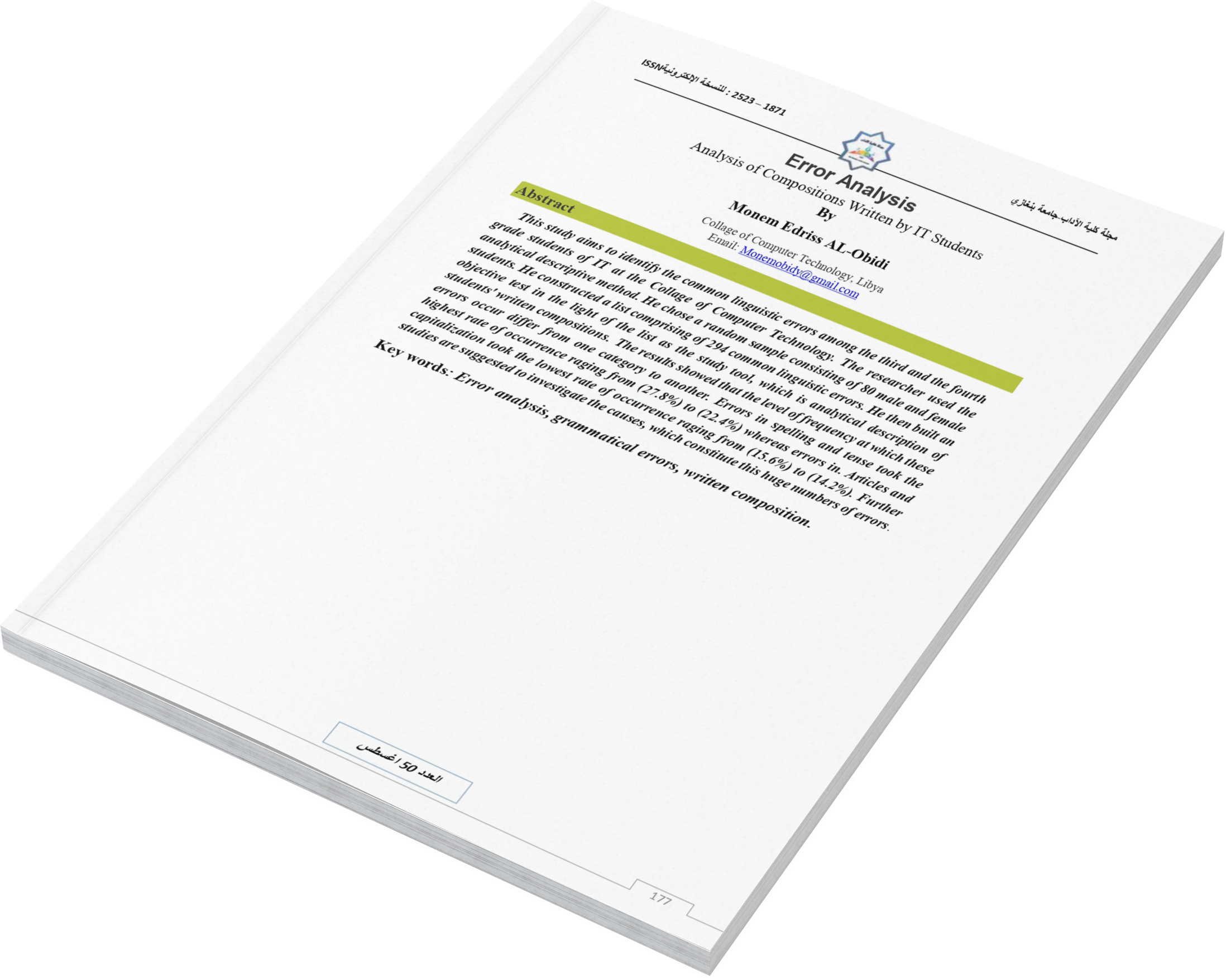
Error Analysis Analysis of Compositions Written by IT Students
DOI:
https://doi.org/10.37376/jofoa.vi50.4462Keywords:
Error analysis, grammatical errors, written compositionAbstract
This study aims to identify the common linguistic errors among the third and the fourth grade students of IT at the Collage of Computer Technology. The researcher used the analytical descriptive method. He chose a random sample consisting of 80 male and female students. He constructed a list comprising of 294 common linguistic errors. He then built an objective test in the light of the list as the study tool, which is analytical description of students' written compositions. The results showed that the level of frequency at which these errors occur differ from one category to another. Errors in spelling and tense took the highest rate of occurrence raging from (27.8%) to (22.4%) whereas errors in. Articles and capitalization took the lowest rate of occurrence raging from (15.6%) to (14.2%). Further studies are suggested to investigate the causes, which constitute this huge numbers of errors.
Downloads
References
- Ancker, W. (2000). Errors and corrective feedback: Updated theory and classroom practice. English Teaching Forum, 38(4), 20-24.
- Brown, H. D. (1994). Principles of language learning and teaching (3rd Ed.). Eaglewood Cliffs, NJ: Prentice Hall.
- Burt, M. K. (1975). Error analysis in the adult EFL classroom. TESOL Quarterly, 9: 53-63.
- Burns, N and Grove, S. (1993). The practice of nursing research: Conduct, critique &utilization, Sanders (Philadelphia).
- Burt, M. K., & Kiparsky, C. (1972). The gooficon: A repair manual for English. Rowley, M.A.: Newbury House.
- Corder, S.P. (1974). Error Analysis, In Allen, J.L.P. and Corder, S.P. (1974). Techniques in Applied Linguistics. Oxford: Oxford University Press.
- Corder, S.P.1967.’’ The significance of Learners’ Errors. IRAL, 5. No.4,1967
- Crystal, D. (1999). The penguin dictionary of language (2nd ed.). Penguin
- Cunningsworth, A. (1987). Evaluation and selecting EFL teaching materials, p 87. London: Heinemann Education Book. 100
- Ellis, R. (1996). The study of second language acquisition, p 710. Oxford: Oxford University Press.
- Eun-pyo, L. (2002). Error analysis on medical students‟ writing. Eulji University, School of Medicine. Accessed on: 1/09/2020. Retrieved from: http://www.paaljapan.org/resources/proceedings/PAAL8/pdf/pdf053.pdf.
- Giri, A (2010). Errors in the use of English grammar. Journal of NELTA, 4, 1-2. Retrieved from http://www.nepjol.info/index.php /NELTA/article/view/4610
- James, C. (1998). Errors in language learning and use. Exploring error analysis. Longman, London – New York. Accessed on: 17/09/2020. Retrieved from: www.springerlink.com/index/q1m7784588u51680.pdf
- Kwok, H. L. (1998). Why and when do we correct learner errors? An error correction project for an English composition class. Accessed on: 16/04/2009. Retrieved from: http://sunzi1.lib.hku.hk/hkjo/view/45/4500101.pdf. 104
- Nation, I. S. P., and Newton J. (2001). Teaching EFL listening and speaking. New York: Routledge/Taylor and Francis Group.
- Norrish, John. 1983. Language Learner and Their Errors. London: Macmillan. Sapir, Edward.1921. Principles Language Learning and Teaching. San Francisco.
- Nunan, D. (2000). Language Teaching Methodology. Malasia: Longman.
- Giri, A (2010). Errors in the use of English grammar. Journal of NELTA, 4, 1-2. Retrieved from http://www.nepjol.info/index.php /NELTA/article/view/4610
- Giri, A (2010). Errors in the use of English grammar. Journal of NELTA, 4, 1-2. Retrieved from http://www.nepjol.info/index.php /NELTA/article/view/4610
- Richards. J.C. Plott, J. and Platt H. 1985. Dictionary of Language Teaching and Applied Linguistics London: Longman.
- Richards, J. C., and Schmidt, R. (2002). Dictionary of Language Teaching & Applied Linguistics. Pearson Education Limited. London: Longman.
Downloads
Published
How to Cite
Issue
Section
License
Copyright (c) 2023 Journal of the Faculty of Arts

This work is licensed under a Creative Commons Attribution-NonCommercial-NoDerivatives 4.0 International License.


